Pūrākau Māori
Why I make Māori Mythic Illustrations.
What are Pūrākau Māori?
Stories, legends, mythology, adventures? They ARE all of these. But they are even more. Pūrākau are containers of knowledge, using metaphors to make knowledge more interesting and interesting to remember.
They hold ways of thinking, behaving and ways of understanding.
They teach us how to be brave, how to be clever, how to make decisions under pressure, how to deal with loss, challenge and uncertainty.
And more than that - they help answer a bigger question - Ko wai tātou? Who are we?
Because inside these pūrākau.. You’ll find patterns of our people. You'll see our values. Our whakaaro. Our ways of moving through the world.
So it is important to carry on these legends. So we can understand a little better who we are, not only as Māori but as New Zealanders, and that YOU can keep them alive for your mokopuna.
When I read these stories, I am first entertained first, but as the esoteric knowledge seeps into my mind, the education follows. Pūrākau Māori are full of great adventures, quests and fantasy beings. But they also reveal messages of what was, and is, considered right and wrong. They can also teach us how to deal with situations we come across.
Here's my first example -
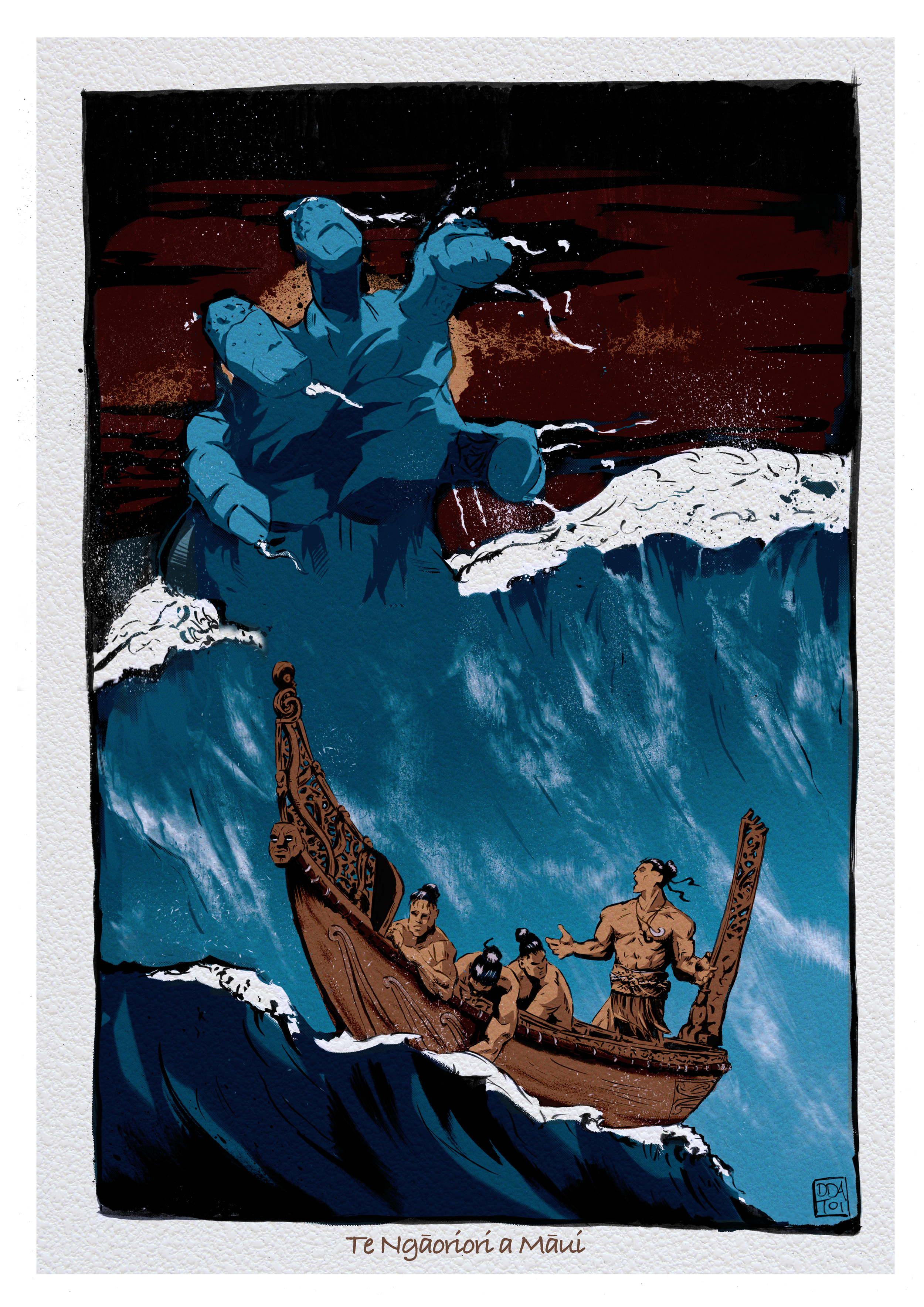
Aboard Nukutaimemeha, Māui and his brothers are tormented by Tangaroa. Māui calms the atua, with song.
Te Ngāoriori a Māui
When Māui was a baby, floating on the ocean after his mother thought he was stillborn, he was rescued by Tawhirimatea and Tangaroa. With the help of both atua, he was washed ashore at his grandfather's Tamanuikiterangi island home. Here Tamanuikiterangi raised him, but he was not alone. Tānemahuta became fond of the boy, as did Tangaroa. They both gave him sacred knowledge they passed on to no other human.
Tangaroa in particular was very fond of Māui, or Mauiui as he originally named him, and showed him his creations and gave him the gift to breathe under water and shapeshift into sea creatures. Tangaroa wished for Mauiui to stay with him in his domain, but Māui wanted to know more about his people and refused this offer. This upset Tangaroa.
Many years later, Māui creates the waka, Nukutaimemeha, to retrieve one of Tangaroa's creations he saw when he was a pēpī. He took three of his 4 brothers, and boarded the magical waka, which was able to move by itself, and knew the way to the sacred place of Tangaroa.
Tangaroa noticed the crew but did not know Māui's plan. Angry with Māui for not accepting his offer, he tormented the brothers. Tossing them about with his hand. Māui-Tikitiki-a-Taranga was angry and began to chant. Māui chanted Tangaroa's song. Tangaroa sent his monsters from the deep to stop the chant, but Māui kept chanting. The monsters from the deep reared their heads and terror filled the hearts and minds of the brothers, and they cried out “Aue!, Aue!, We are going to die!” But the monsters from the deep fled in fear when they heard the chant. Tangaroa paused in his anger, and listened to the chant. Mauiui was singing to him, Māui was asking him for life. Then the song changed, and Mauiui sang to Tangaroa about the love between a human child, and a powerful god. Tangaroa nodded his head sadly as he heard the song, so Tangaroa sent Mauiui's old playmates to sing with him, and then he withdrew from the fishing ground.
So this moment in the story enchants an epic visual of Tangaroa and the crew of Nukutaimemeha, but that is only one thing that attracted me to this scene. This emotional beat, Maui singing a lullaby that tames the fury of the atua. It is not strength or might that Maui uses to solve this hostile situation, its kupu, its waiata.
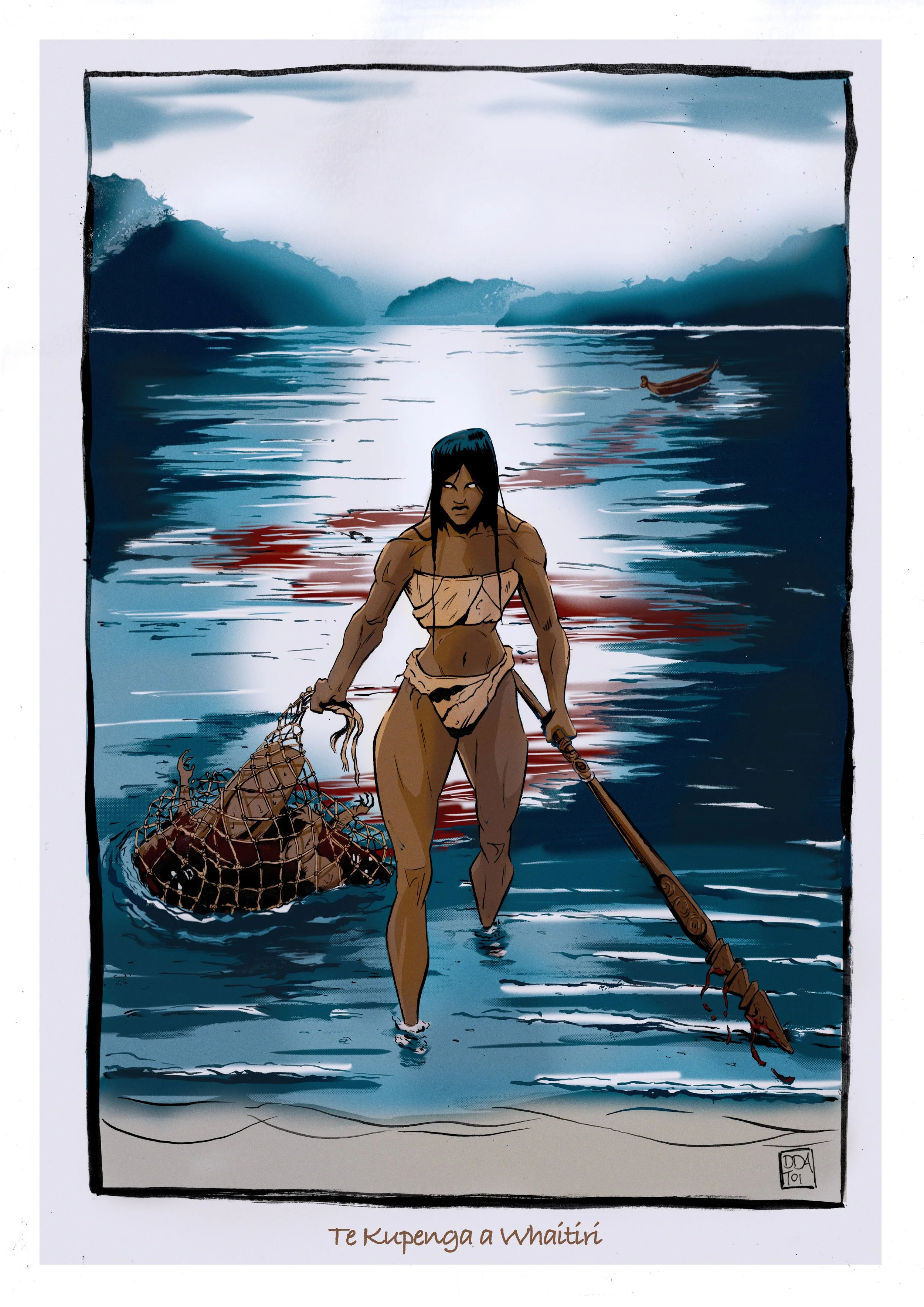
Whaitiri brings in her kupenga with her soon to be devoured catch.
Te Kupenga a Whaitiri
Long ago, Whaitiri, the atua of thunder, lived in the overworld with her husband and children. Whaitiri was a grim figure, and had a habit her husband did not share, the taste for human flesh.
One day she heard of a man named Kaitangata - which means man eater - living in Te Ao Marama, Earth, and felt like he would be a more fitting mate for her. She descended to Earth and met Kaitangata. Now, he was a gentle man, already married with children, who spent his days fishing to feed his family. Whaitiri killed her slave and took out her heart and liver and gave them to Kaitangata as a token of her affection. Kaitangata was horrified.
Kaitangata wasn't the best fisherman, as he did not know of the art of making fish hooks with barbs. Whaitiri saw the reason for his failure and gave him her own barbed fish hook. While fish was a fine diet for humans, Whaitiri was not satisfied. One day, when Kaitangata was away fishing and out of sight, she grabbed her net and swam out to a waka where two of Kaitangata's relatives were fishing. Whaitiri clutched the side of the waka and thrust her tao into him. He fell into the water and she put him into her net. The other man tried to kill her with his spear but Whaitiri killed him with her Kōripi and he too fell overboard and was gathered in her net.
She dragged the bodies in her net to shore, and went up to the village to tell the women to bring her net ashore. To their horror, they saw the dead bodies. Soon after, Kaitangata returned and he too was horrified at what he found.
Whaitiri requested Kaitangata to recite the karakia that were used when human flesh was offered to the gods, but he did not know them, and eventually she performed them herself. But even she did not know the proper words, and failed in lifting the tapu.
In time, this act caused Whaitiri to gradually lose her sight until she became blind.
So an epic and horrific scene that easily caught my mind's eye and stuck with me. But eventually I noticed some esoteric knowledge buried in this tale. Whaitiri makes a big assumption that Kaitangata is a man eater. Maybe if she got to know him before committing to this marriage things may have turned out differently. Also, when she fails to recite the proper incantations and follow the right protocol, she is then faced with her repercussions.
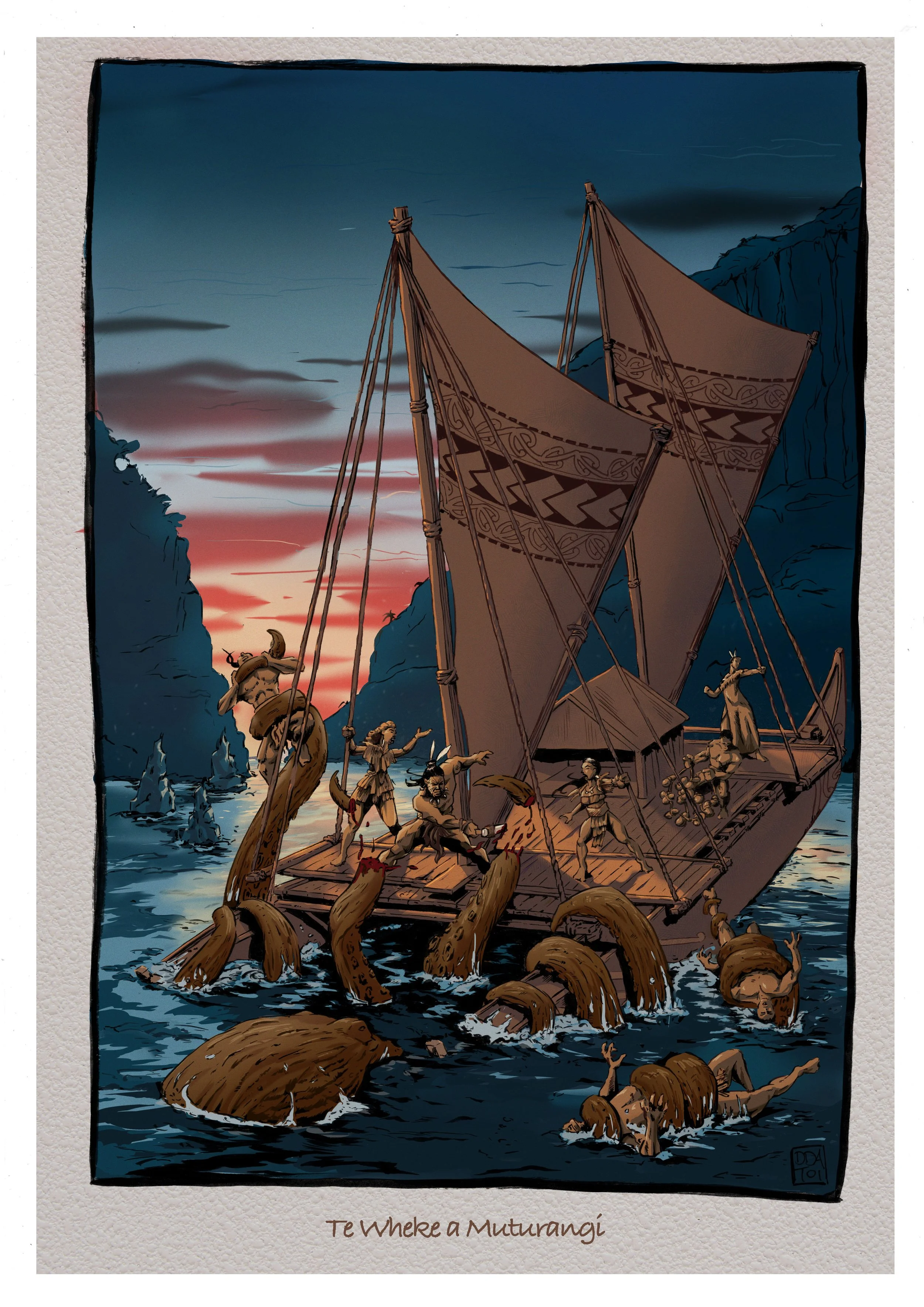
Onboard the legendary waka, Matahourua, Kupe slays the magical wheke with Rakatuwhenua.
Te Wheke a Muturangi
Kupe was a powerful chief with great mana that spread across the pacific. But he also had powerful enemies, one of which was Muturangi, who had a giant Octopus(wheke) as a pet.
Muturangi devised a plan that would curb the mana of Kupe in the eyes of his own people, the people would starve and Kupe would lose his mana.
When out fishing with his people, Kupe could not catch any fish and noticed the giant wheke was to blame. Kupe was told by his tohunga that he would have to kill the wheke to restore the ocean bounty. Excited by this challenge, Kupe gathered his whānau and they prepared the great waka Matahourua.
The wheke was chased across the pacific until eventually Kupe's second wife, Kuramarotini, caught a glimpse of something on the horizon. “ E Kupe” she called “he ao, he ao, he aotearoa! (a cloud, a cloud, a long white cloud)
Kupe found the wheke hiding in a cave where she had laid her eggs but she escaped Kupe's wrath. The chase continued and at last the foamy trail of the wheke turned in towards land at one of the many entrances to a wilderness of inlets. The wheke had made a mistake- she was trapped in the sound known to this day as Whekenui.
With shouts and screams, the crew closed in, beating, chopping and stabbing at the tentacles, trying to reach the head of the wheke. The magic power of the wheke enabled her to heal quickly. She lifted people out of the waka and flung them far off onto rocks or held them under water to choke and drown. The sea frothed with a mixture of human and wheke blood. Many of the crew now struggled in the water, easy prey.
Kupe shouted for gourds. He quickly lashed them together with flax rope and threw them into the waves to look like men's heads. The wheke, believing them to be more heads to attack, knotted her tentacles around them to drown them. While she was thus occupied, Matahourua came up alongside her, Kupe raised Rakatuwhenua and brought it down on the head of the wheke, full force, cleaving it and leaving a bloody, slaughtered creature floating softly on the red water.
The magic of Rakatuwhenua had defeated the power of the wheke. A great cheer went up from the exhausted warriors.
Kupe’s journey connects with us as a metaphor for the struggle against adversity and the pursuit of knowledge. It teaches us courage, leadership and the ability to find one’s way through both the stars and spiritual guidance.
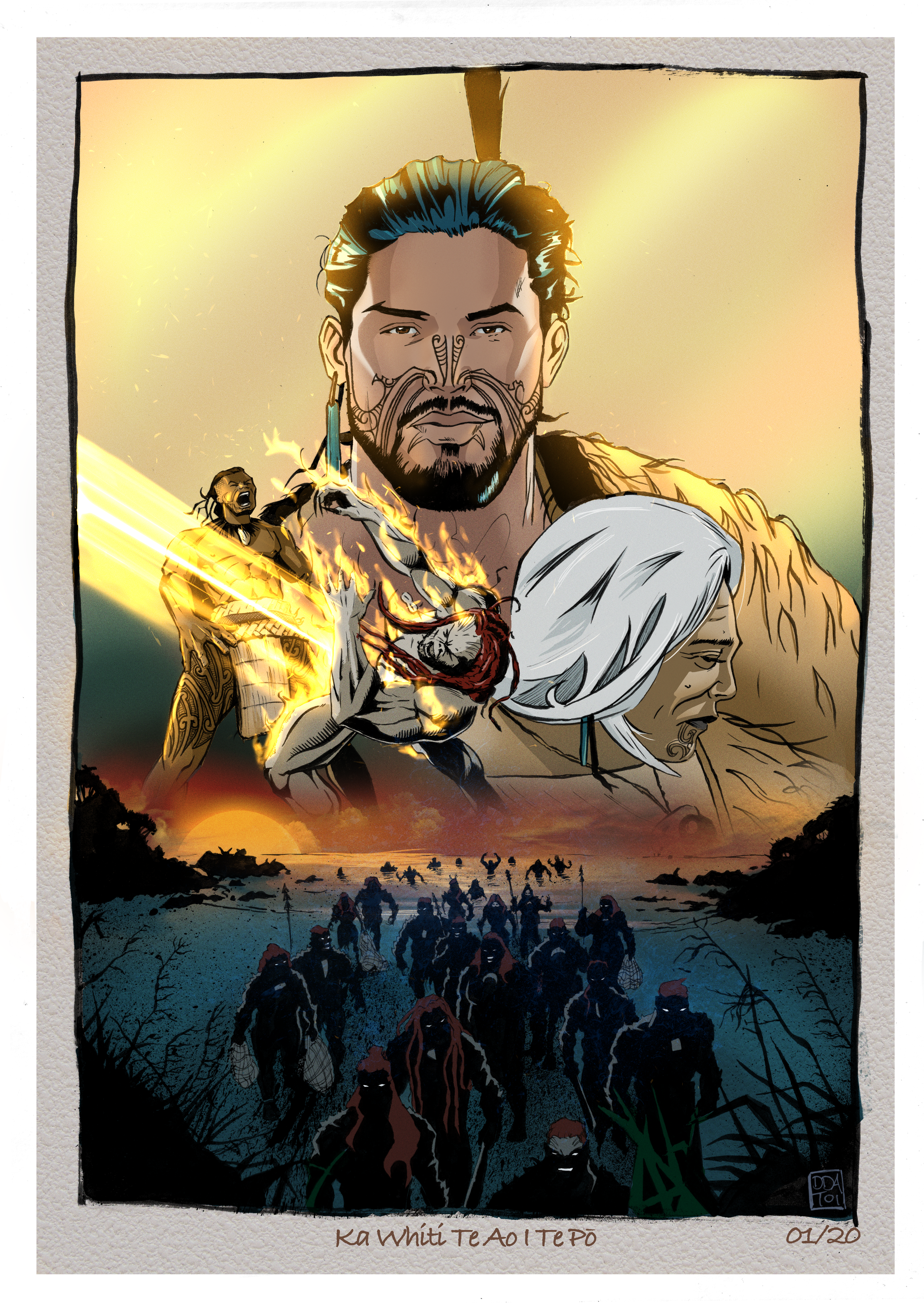
Tāwhaki and Karihi clash with the creatures from the sea, Ponaturi.
Ka Whiti te ao i te Pō
Tāwhaki is not as well known as Māui, but he is a legend of equal mana. Through his many adventures he achieved many great deeds and even became an atua.
Tāwhaki is told of an attack on his parents’ pākainga. With that news comes an even greater loss: the death of his father, Hema, and the capture of his mother, Urutonga, by the Ponaturi.
Determined to act, Tāwhaki and his teina Karihi set out and eventually discover Manawatāne, the hidden dwelling of the Ponaturi. There they are reunited with their mother. Urutonga warns them of the cruelty of the Ponaturi and urges them to leave while they still can. She tells them of the Ponaturi’s sick amusement — how they rattle Hema’s bones on the porch of Manawatāne.
Tāwhaki refuses to retreat. He is resolute in freeing his mother and avenging his father.
Urutonga explains that the Ponaturi are creatures of the sea by day, but come ashore at night to sleep. It is her duty to warn them before dawn so they can return to the moana. Hearing this, Tāwhaki immediately understands the nature of the beings they face and devises a plan.
Through karakia, Tāwhaki and Karihi cloak themselves in invisibility and hide within the ceiling of Manawatāne. When the Ponaturi return in their hordes, the brothers descend from their hiding place. Together with Urutonga, they block the windows and doors.
As the Ponaturi ask whether it is time to rise, Urutonga replies: “No. It is the big night, the long night — the night when sleep is good. Go back to sleep.”
When Tamanuiterā stands high in the sky and the Ponaturi ask again, she finally answers yes.
At that moment, Tāwhaki and Karihi tear away the coverings from the windows and doors. Daylight floods Manawatāne, and the Ponaturi are destroyed by the sun. The brothers then burn Manawatāne and destroy the remains of the Ponaturi, ending their terror.
One of my favourite moments in pūrākau is the battle between Tāwhaki and the ponaturi. Not only does it have the revenge story arc, but powerful creatures that come out at night, heroic cunning but even more. Tāwhaki and Karihi dont simply battle the ponaturi, they use strategy, knowledge and cunning.
Why I make Pūrākau Posters?
Pūrākau māori are special to me for many reasons. Firstly, they help me connect to my tīpuna, as these are their stories in which they passed on knowledge. This helps me understand, Ko wai au? Who am I?, a little better. These stories are now ours, not to hold onto, but to keep alive and pass on to the next generation. This helps give me purpose. And that also makes these stories unique to us, stories that belong to us, stories we can enjoy that are not from Hollywood but right here in Aotearoa. And last but definitely not least, these stories are full of magic, monsters and great heroes, everything a fantasy buff needs from a story.